
Router Bit Guide
CNC Router Bits Guide: Types, Materials, and How to Choose the Right Bit
Jun-25-2026
CNC Router Bits are the cutting tools that make CNC routing possible—whether you’re cutting cabinet parts, carving 3D reliefs, engraving signage, or machining plastics and non‑ferrous metals. The right bit choice directly affects cut quality, efficiency, tool life, and overall production cost.
In this guide, you’ll learn:
- What CNC router bits are and how they work
- The most common bit types and where each one fits best
- Carbide vs HSS differences (and why most CNC applications prefer carbide)
- A practical checklist for choosing the right bit
- What to prepare if you need customization
If you’re looking for a complete product overview, start now.
What Are CNC Router Bits?
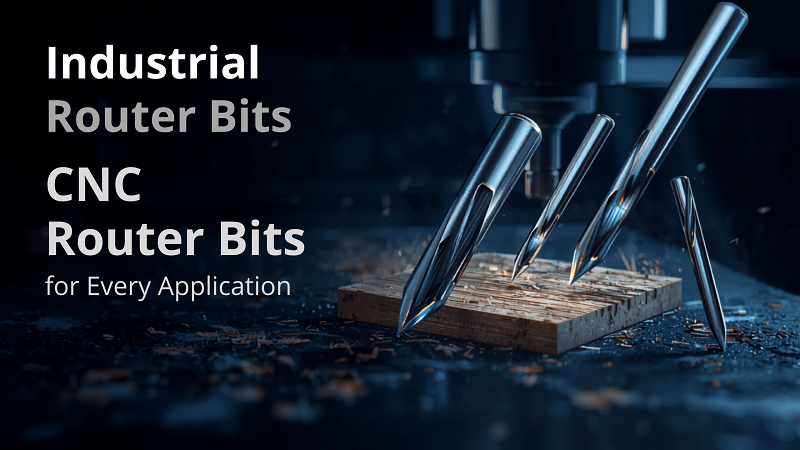
CNC Router Bits are rotary cutting tools used in CNC machines to remove material and create precise shapes, grooves, pockets, contours, and surface finishes. They rotate at high speed and cut materials such as solid wood, MDF, plywood, acrylic, plastics, and non‑ferrous metals (like aluminum).
Most CNC router bits are made from solid carbide or carbide‑tipped steel because CNC machining demands high wear resistance, heat tolerance, and consistent edge sharpness over long production runs.
Main Types of CNC Router Bits
Different geometries are designed to solve different cutting problems—chip evacuation, surface finish, edge quality, and strength. Below are the most common categories you’ll see in CNC woodworking and general routing applications.
1) Straight Router Bits
Straight bits are a classic, general‑purpose option for grooves, dados, and basic trimming. They’re often used for joinery, panel work, and straightforward profiling where you want predictable, clean cuts.
Best for: grooves, dados, basic trimming, general woodworking.
2) Spiral Router Bits
Spiral bits use a helical cutting edge to improve chip removal and reduce heat buildup. This typically produces smoother finishes and more stable cutting in CNC operations.
Spiral bits are commonly selected based on how they manage chips and edge quality:
Upcut spirals pull chips upward and clear the cut efficiently (often better for deep slots and fast material removal).
Downcut spirals push chips downward to reduce top‑edge tear‑out (often better when top surface finish is the priority).
Compression spirals combine upcut and downcut behavior to protect both top and bottom surfaces—especially useful in plywood and laminated panels.
Best for: slotting, pocketing, profiling, production routing, improved finish.
3) Ball Nose Router Bits
Ball nose bits have a rounded tip that makes them ideal for 3D contouring and smooth surface transitions. They’re widely used for relief carving, mold work, and detailed shaping where you want gradual curves rather than flat steps.
Best for: 3D carving, contouring, relief work, molds, complex surfaces.
4) V Groove Router Bits
V bits are designed for engraving, lettering, chamfers, and decorative grooves. They’re a staple in signage, artistic woodworking, and precision marking.
Best for: engraving, lettering, decorative lines, chamfering.
Applications in Woodworking and CNC Machining
Because CNC router bits come in many shapes and sizes, they are used across industries that require repeatable accuracy and efficient material processing, including:
- Furniture manufacturing: profiling, pocketing, edge finishing
- Cabinet making: dados, rabbets, nested-based cutting
- Interior decoration: decorative panels, carved patterns, trim parts
- Sign making and advertising: engraving letters and logos on wood and acrylic
- Acrylic and plastic processing: clean cutting, controlled heat, reduced melting
- Industrial CNC machining: prototypes, jigs, molds, custom components
Matching the bit geometry to the material and the operation is the fastest way to improve edge quality and reduce rework.
Materials: Carbide vs HSS (and What to Expect)
Tool material strongly affects wear resistance, heat tolerance, and how long the cutting edge stays sharp.
Solid Carbide
Solid carbide is the most common choice for CNC production because it offers excellent hardness and wear resistance. It holds a sharp edge longer under high spindle speeds and extended cutting time, which helps maintain consistent results in batch production.
Best for: high-speed CNC work, longer tool life, consistent finish, production environments.
High-Speed Steel (HSS)
HSS is typically more affordable and easier to sharpen, but it wears faster than carbide—especially in high-speed CNC conditions. For light-duty work or limited runtime, HSS may be acceptable, but it’s usually not the first choice for modern CNC routing where uptime and repeatability matter.
Best for: light-duty use, lower-cost applications, non-production workloads.
How to Choose the Right Router Bit
Use this checklist to select a CNC router bit that fits your job requirements without overcomplicating the process:
1) Material being cut
Wood, MDF, plywood, acrylic, and aluminum behave differently. The best bit for one can perform poorly on another.
2) Operation type
- Cutting out (profiling)
- Slotting / grooving
- Pocketing
- Engraving / lettering
- 3D carving / contouring
Different operations require different geometries for edge quality, chip control, and cutting stability.
3) Surface finish requirement
If you need clean edges with minimal sanding, prioritize geometry designed to reduce tear-out and improve finish consistency.
4) Bit dimensions
- Choose appropriate:
- Cutting diameter
- Cutting length (depth capacity)
- Shank size (must match your collet/tool holder)
5) Machine compatibility
Spindle speed capability, rigidity, workholding strength, and dust/chip extraction all affect how aggressively you can cut and how cleanly chips evacuate.
.png)
Customization Options (OEM/ODM)
Standard tools cover many jobs, but production environments often need optimized geometry, special sizes, or consistent branding across a product line. Typical customization includes:
- Diameter and cutting length
- Shank size and overall length
- Flute count and geometry adjustments
- Marking (laser logo / SKU)
- Packaging and labeling options
If your workflow requires tailored specifications, for tailored requirements and OEM needs: Custom Router Bits.
Conclusion
CNC Router Bits are fundamental to modern CNC routing in woodworking, signage, plastics, and industrial manufacturing. By understanding common bit types, selecting the right tool material, and using a structured selection checklist, you can improve surface finish, reduce tear-out, increase efficiency, and extend tool life.